Why an AI Model Marketplace is the Smartest Way to Access Multiple Models
The Shift from Single-Model Lock-In
For the past few years, most teams approached AI by picking one large language model and building everything around it. You chose GPT-4 because it was the strongest at reasoning. Or you picked Claude because its safety guardrails matched your compliance needs. Or you went with an open-source model to keep costs predictable. Each choice came with trade-offs. Switching later meant rewriting prompts, adjusting parameters, and often retesting entire pipelines.
That approach is starting to feel outdated. Model capabilities are evolving fast, and no single provider dominates every task. Some models excel at creative writing. Others are faster for summarization. A few are remarkably cheap for classification work. The question is no longer "which model is best?" but rather "how do I use the best model for each job without managing ten different API keys?"
This is where an ai model marketplace becomes useful. Instead of committing to one provider, you get a single access point to many models. The marketplace handles routing, authentication, and often cost optimization behind the scenes. You send one request, and it decides which model should handle it based on your preferences or the marketplace's routing logic. For teams that need flexibility without operational overhead, this model is a natural fit.
How a Marketplace Changes Your Workflow
Think about what happens when you want to compare outputs from three different models today. You sign up for three accounts, manage three sets of API keys, read three different documentation pages, and handle three billing cycles. If one provider changes its pricing or deprecates a version, you scramble to update your integration. Every new model you want to try adds another layer of maintenance.
An ai model marketplace flips that around. You authenticate once, through a single key. The marketplace API abstracts the differences between providers. You specify the task and perhaps a quality tier, and the marketplace selects the model. If the marketplace supports competitive seller routing, you might even get a better price than any single provider's list rate because multiple sellers compete to fulfill your request. That is a meaningful advantage for startups running high volumes of inference calls.
The practical benefit is speed. When a new model launches, you do not need to update your code. The marketplace team handles the integration. You just see the new option appear in your dashboard or become available through the same API endpoint. For a team that moves fast, that kind of frictionless experimentation is valuable.
What to Watch Out For
Marketplaces sound convenient, but they are not magic. You should check a few things before relying on one for production workloads.
Latency overhead. Every routing layer adds a small delay. A good marketplace minimizes this, but it is not zero. If your application requires sub-50 millisecond responses, you might need to benchmark a marketplace against a direct connection. For most chat and content generation use cases the difference is negligible, but it is worth measuring.
Model quality variance. Not all sellers on a marketplace use the same fine-tuned version or the same hardware. Two sellers offering "GPT-4" might return slightly different outputs because one runs a quantized version or a different sampling configuration. The UberLLM ai model marketplace approach addresses this by routing requests based on seller reputation and performance metrics, but you should still test consistency on your own data.
Data handling. When you send a prompt through a marketplace, multiple parties might handle it. Read the marketplace's privacy policy carefully. Some marketplaces guarantee that your data is not logged or used for training. Others do not. If you deal with sensitive information, you need to know where your data goes and whether it stays encrypted in transit and at rest.
Fallback behavior. What happens when the cheapest seller is down? A solid marketplace falls back to another seller automatically. A less mature one might return an error. Check the marketplace's reliability guarantees before you depend on it for customer-facing features.
Who Benefits Most from This Model
Not every team needs a marketplace. If you run one model for one task and that model's pricing stays stable, you might not gain much. But three types of teams see clear advantages.
Multi-task teams. If your product uses AI for summarization, classification, and creative generation, you likely need different models for each. A marketplace lets you route each task to the best model without maintaining separate integrations. You define the routing rules once and let the marketplace execute them.
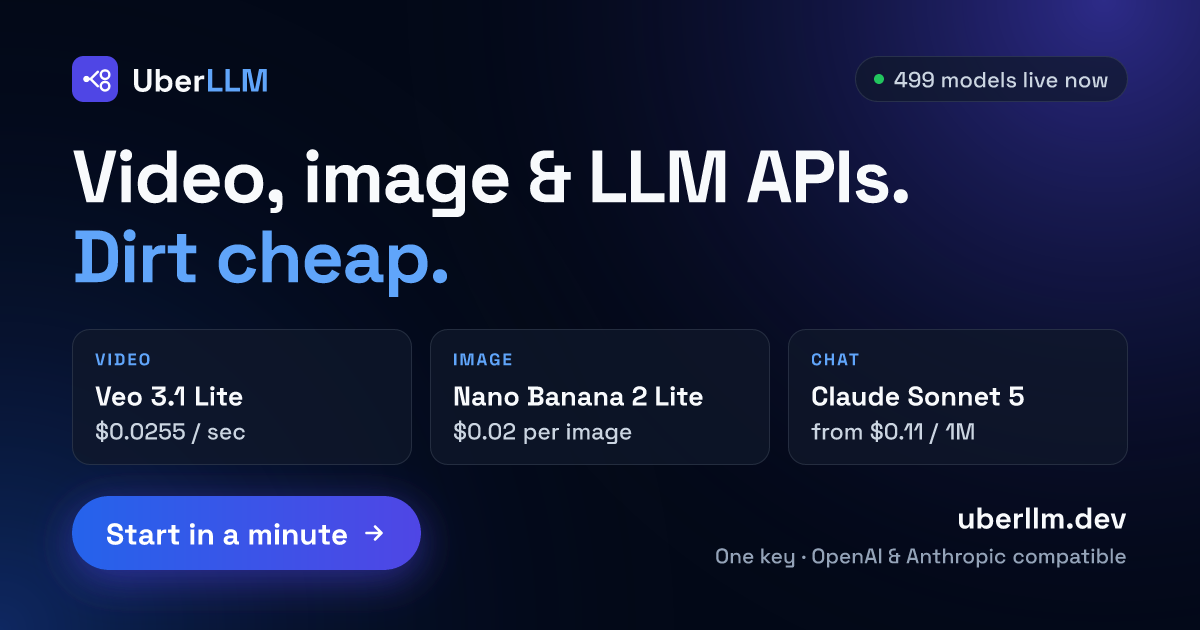
Cost-conscious startups. Margin matters when you are scaling. Competitive routing on a marketplace often drives prices below what any single provider offers. The UberLLM ai model marketplace, for example, connects buyers with multiple sellers, so you pay less than list price for the same model output. Over thousands of requests, those savings add up.
Teams that experiment constantly. If you regularly test new models or swap providers to stay current, a marketplace reduces the switching cost. You do not need to rewrite code every time you try a new model. You just update a configuration setting or add a new model name to your request. That lets you iterate faster and make data-driven decisions about which model works best for your specific use case.
Practical Advice for Getting Started
If you decide to try an ai model marketplace, start small. Pick one task that is not customer-facing and route it through the marketplace. Monitor latency, output quality, and cost for a week. Compare the results against your current setup. That will tell you whether the marketplace adds value or introduces too much overhead for your use case.
Second, test the fallback behavior manually. Temporarily block the primary seller in your routing configuration and see what happens. Does the marketplace choose another seller seamlessly? Does it return a meaningful error? Knowing this before a real outage saves headaches later.
Third, read the marketplace's documentation for routing logic. Some marketplaces let you set rules based on model name, price cap, latency threshold, or seller rating. Others offer simple round-robin routing. The more control you have, the better you can optimize for your specific priorities. The UberLLM ai model marketplace provides granular routing options, but not every marketplace does. Check before you commit.
The Bigger Picture
The trend toward model diversity is not slowing down. New models appear every month, each with different strengths, weaknesses, and pricing models. Building your infrastructure around a single provider means you miss out on improvements from others. An ai model marketplace is a practical hedge. It keeps your options open, reduces the cost of switching, and lets you take advantage of competition in the model provider space.
That said, a marketplace is only as good as its reliability and its seller network. A marketplace with few sellers offers little advantage over a direct connection. A marketplace with opaque routing or poor latency can hurt more than it helps. Choose based on your actual workload, not on hype. Test, measure, and decide.
For teams that do their homework, a marketplace can be the difference between maintaining a fragile single-model pipeline and running a flexible, cost-effective multi-model system. It is a shift worth considering.
Ends · UBERLLMAIMODELDIGEST